

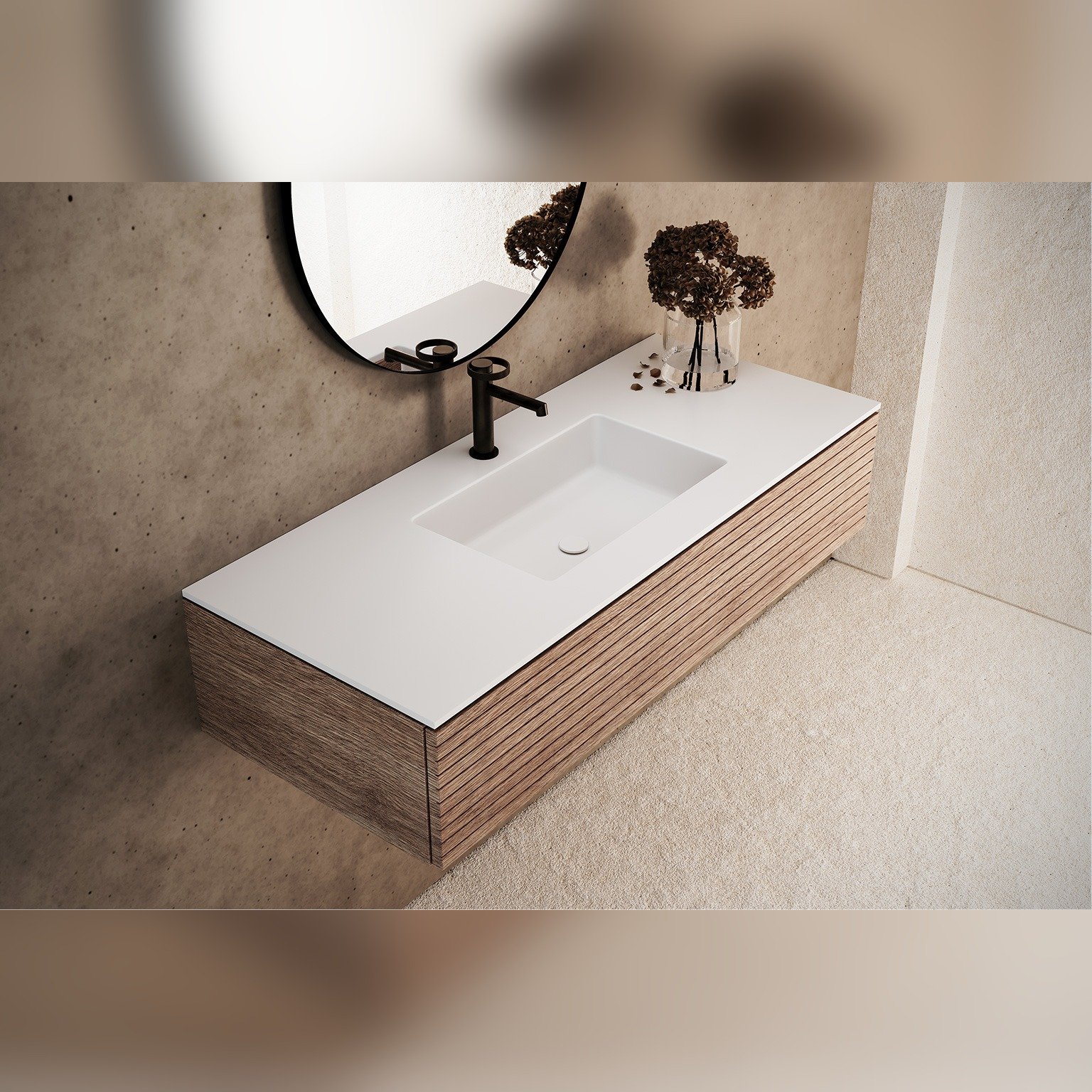
Corian®: what it is and how it differs from Krion®, Silestone® and Dekton®
Corian® is the best-known brand name for Solid Surface, the material Solid Creaciones uses to make every bathroom accessory. This page brings together its definition, its official technical properties and how it differs from other solid surfaces such as Betacryl® or Janicryl®.
For real-life examples of shower trays, accessories and bathroom furniture, see our complete guide to Solid Surface uses (in Spanish).
Density
1.7 g/cm³
Water absorption
0,05%
Flexural strength
68.9 MPa
Official DuPont™ warranty
10 years
Solid Surface is a composite material made from a blend of acrylic or polyester resins and natural minerals, originally developed as a solid, hygienic and mouldable alternative to natural stone.
Unlike other materials:
- It is non-porous
- It has a homogeneous structure
- It allows invisible joints
- It can be repaired if worn or scratched
The best-known Solid Surface brands include Corian®, Betacryl® and Janicryl®, all used in high-end bathroom projects across Europe.
Corian®, Betacryl and Janicryl: common brands in bathroom projects
Although Solid Surface behaves similarly across brands, each one has nuances that matter to professionals:
- Corian®
The industry benchmark, with a wide range of colours and finishes, widely used in premium projects. - Betacryl
A good balance between technical performance and cost, common in functional applications. - Janicryl
A solid choice for contract projects where durability and uniformity come first.
The choice depends on the budget, the level of the project and the specific application, rather than on any deep structural differences.
Corian® in figures: official DuPont™ technical data
This is what the official DuPont™ technical data sheet (Corian® Solid Surface Technical Bulletin, K-26829) says about the material we use to make every piece:
- Density: 1.7 g/cm³
- Water absorption: 0.05% in 24 hours — practically zero, the technical basis for it being a non-porous material
- Flexural strength: 68.9 MPa (10,000 psi)
- Tensile strength: 41.4 MPa (6,000 psi)
- Compressive strength: 110.3 MPa (16,000 psi)
- Barcol hardness: 56
- Dynamic coefficient of friction (slip resistance): 0.59–0.70 with a matt finish on a wet surface — the technical reason we use Corian® for shower trays and benches
- Fire rating: Class A (NFPA 101), flame spread index below 25 — which is why it is common in contract and hospitality projects
- Microbial resistance: highly resistant to mould growth (UL 2824 test)
- Impact resistance: no fracture in the ball impact test, even on 6 mm thick pieces
- Heat resistance: no visible change from boiling water or heat in NEMA tests; for continuous use, avoid exceeding 100°C without protection
These values apply to 12 mm solid pieces and may vary slightly depending on the finish. Source: official DuPont™ Corian® Solid Surface technical data sheet.
Basic maintenance
Solid Surface needs very little maintenance: regular cleaning with mild soap, avoiding highly abrasive products, and if micro-scratches appear, light sanding restores the original finish. With normal use, it keeps its appearance for years.
Want to see the material in real pieces?
Explore our collections of Corian® bathroom accessories, discover real uses and applications in our complete guide (in Spanish), or if you are working on a professional project, see our terms for construction companies, architects and interior designers.
Corian® vs Krion® vs Silestone® vs Dekton®
For kitchen worktops, the most searched comparison brings together materials from two different families. Corian® and Krion® are Solid Surface; Silestone® and Dekton® are mineral surfaces by Cosentino, with a different nature and manufacturing process. The best choice depends on the worktop’s function, the design and the acceptable level of maintenance, not just on appearance.
Corian® vs Krion®
These are the closest options in this comparison because both are Solid Surface: they combine an ATH-based mineral filler with acrylic resins and allow visually seamless surfaces. The practical difference should be assessed on the specific collection — colour, finish, format, joining system — not on the brand in the abstract.
Corian® vs Silestone®
Silestone® is not Solid Surface: it is a hybrid mineral surface by Cosentino, with a low crystalline silica content, which may include quartz depending on the collection. It does not offer the same kind of forming or surface renewal as an acrylic solid surface such as Corian®; its cutting, installation and cleaning guidelines are those set by Cosentino for each product.
Corian® vs Dekton®
Dekton® is not Solid Surface either: it is an ultra-compact surface by Cosentino, sintered from a blend of minerals. It is designed for large formats and for the heat and scratch demands of kitchens and outdoor use. Corian® is more interesting when a project prioritises visual continuity, shaped forms and the ability to remove surface marks. They are not automatic substitutes.
Quick comparison for kitchen worktops
| Material | Type of material | Common use | Key factor when comparing |
|---|---|---|---|
| Corian® | Acrylic-mineral Solid Surface | Worktops, washbasins, furniture and interior cladding | Continuity, piece design and repair of surface damage depending on the case |
| Krion® | Mineral-acrylic Solid Surface | Worktops, washbasins, cladding and furniture | Alternative from the same family; compare range, finish and fabrication |
| Silestone® | Hybrid mineral surface | Kitchen and bathroom worktops and cladding | Mineral surface designed for worktops; follow the collection’s guidelines |
| Dekton® | Ultra-compact mineral surface | Worktops, cladding, flooring and outdoor use | Performance against heat, scratches and large-format applications |
Advantages and limits of Corian® in particular
- Homogeneous, non-porous material, useful for worktops, washbasins and interior pieces with simple everyday cleaning.
- Discreet joints and design freedom compared with stone or an ultra-compact surface.
- Surface marks can be repaired in some cases, depending on the damage, colour and finish.
- Not suitable for every thermal demand: avoid direct heat without protection, as the DuPont™ technical data above points out.
- It can scratch or mark; repairability does not mean immunity to wear or a heavy impact.
- Price per metre is not enough to compare: design, joints, fabrication and installation also count.
Frequently asked questions
Are Corian® and Solid Surface the same thing?
Not exactly. Solid Surface is the category of materials; Corian® is a specific DuPont brand within that category, like Krion®, Betacryl or Janicryl.
What is the difference between Corian® and Krion®?
Both are Solid Surface with a similar mineral-acrylic base. They should be compared by collection, finish and specific application, not just by brand.
What is the difference between Corian®, Silestone® and Dekton®?
Corian® is an acrylic-mineral solid surface. Silestone® is a hybrid mineral surface and Dekton® an ultra-compact mineral surface: their manufacturing processes, uses and care are not equivalent.
Why does Solid Creaciones use Corian® rather than Krion® or Silestone®?
Because our bathroom accessories — towel rails, robe hooks, shower trays, bins — make the most of exactly what the technical data above shows: low water absorption, a good slip-resistance coefficient and repairability, which matter more in accessories than in a kitchen worktop.

Solid Surface experts. We create Solid Surface (Corian®) bathroom accessories with unique designs that stand out for their style, durability and elegance.
Contact
- +34 670 96 65 09
- +34 961 01 74 19